Is Your Patchouli Oil Genuine? Label, Certificate, Lab
Here is the honest truth about checking patchouli oil before you pay: your nose can only do so much. The oddities that matter in this trade are the ones built to pass a sniff test, and the evidence that settles it is a laboratory report that a seller either hands over or does not. What follows sorts the checks into three tiers, from the kitchen table to the lab bench, so you know how much weight to give each one.
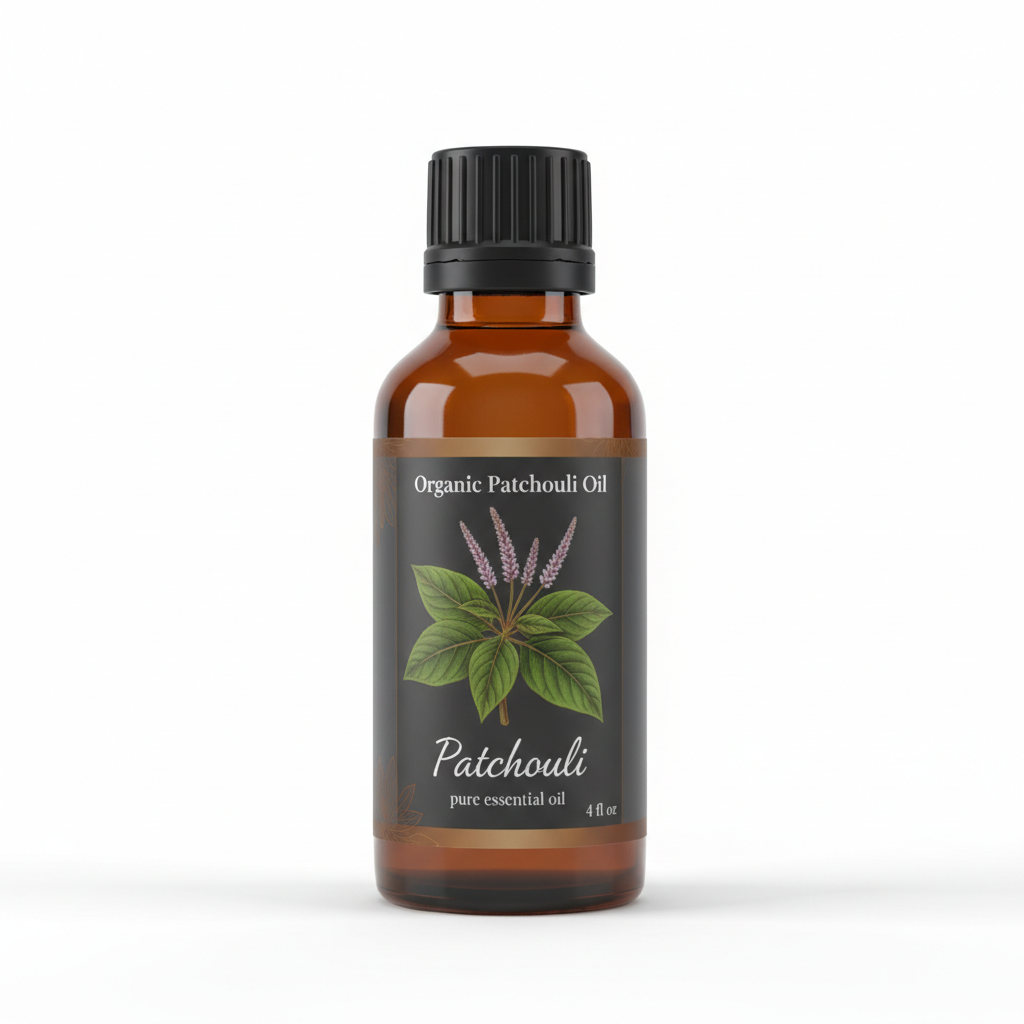
Patchouli Essential Oil
Our own Patchouli Essential Oil, in sizes from 0.5 oz to bulk.
From $20.99
Shop Now →What your nose can and cannot tell you
PROSEA, the plant-resources reference, lists what has been sold as patchouli oil: oils from other plants (Chinese patchouli, Microtoena insuavis, is the example it names) and heavy solvents such as benzyl benzoate and propylene glycol as extenders. A crude substitute might smell wrong. A small addition of an odourless extender might smell exactly like the oil it stretches, so your nose is least reliable on the easiest thing to hide.
It also works the other way. Genuine patchouli varies a lot. PROSEA describes oil that matures after distillation and loses sharp-green, wet-earthy and minty notes, Indonesian-distilled oil as dark orange or brownish, and European or US-distilled oil as pale orange or amber. A fresh oil, an aged oil and a differently distilled oil can all be real and still smell different, so "that smells off" is not a verdict. Our dark versus light comparison goes into the range.
Tier one: the label
A good label does four things. It names the plant, Pogostemon cablin, since "patchouli" alone could be an oil, an extract or a fragrance. It names the part (leaf) and the process (steam distilled). It lists one ingredient; US cosmetic rules require ingredients in descending order of predominance and let "fragrance" stand in for a scent blend, so "patchouli" on the front and "fragrance" on the back is a different product. And its colour fits the story the seller tells. A colour that contradicts the stated origin is a question worth asking, though colour alone cannot prove anything.
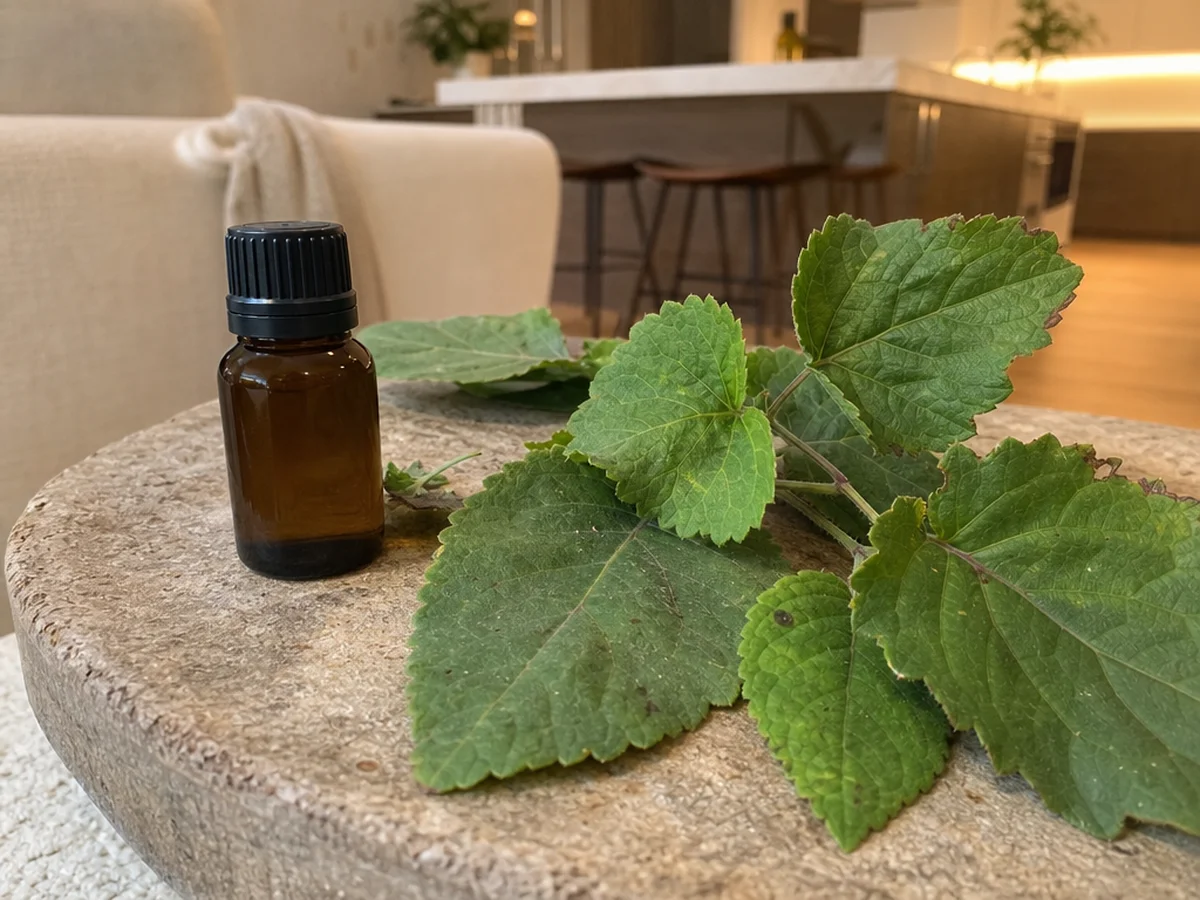
Our bottle label carries the product name, the botanical name Pogostemon cablin and the size. For batch details on ours, ask us through the contact page.
Tier two: the certificate
A certificate of analysis is only as helpful as what it prints. The published standard for patchouli oil is ISO 3757:2002, last confirmed in 2023. Physical constants such as density, refractive index and optical rotation tell you the oil sits inside a stated range, which is helpful but a broad check. Composition tells you more. In an assessment by the European Food Safety Authority, five batches of one applicant's oil averaged about 34% patchouli alcohol by GC-MS, and the same report lists the other main components. Use that as a yardstick for reading a report, not as a pass mark for any other oil.
The Certificate of Analysis we publish is for one batch. It gives appearance and smell results ("Complies") and the stated standard ranges for density (0.950 to 0.975), refractive index (1.505 to 1.515) and optical rotation (-38 to -55 degrees). If you need GC-MS data, an adulterant screen or organic documentation with certifier name and certificate number, ask us in writing through the contact page and get the answer in writing before relying on it. Our GC-MS guide walks through the reading order.
Tier three: the laboratory
Even a thorough report has limits. In a 2018 study, researchers ran 60 MHz NMR on 75 genuine patchouli oils, 10 commercial ones, 10 other essential oils and 17 adulterants. They spotted 14 of the adulterants easily, found gurjun and copaiba balsams difficult, and could not detect one at all, and they describe NMR as complementary to GC-MS. No single method catches everything. A report that names its methods is worth more than one that only says "tested", and a claim of "screened for added oils" deserves the follow-up question: how?
Keep a small file
Whichever tier you stop at, keep a small record for each oil you bring home: a photo of the label, the date, the batch details if the seller gives them, and any written reply you received to your questions. It takes five minutes and saves you a great deal of guessing later, especially if a blend turns out differently from the last one.
It also pays to smell the oil again a week after it arrives. Patchouli settles in the bottle, so your first impression and your second may differ, and having both written down helps you judge it fairly.
One more practical tip: when you compare two oils, change only one thing at a time. Smell them on matching strips, at the same moment, in the same room, with a break for fresh air between. It sounds fussy, and it is the quickest way to learn what your own nose can tell you.
A sensible path
- Buying a few ounces for a diffuser or a body oil at the skin ranges in our dilution chart: read the label and start small.
- Buying for products you will sell: read the label and the certificate, and ask for GC-MS in writing.
- Buying in pound quantities, or making claims about composition on your own label: do all three tiers and send your own sample to a laboratory you choose.
The same questions apply to organic claims. Whether an oil is organic is documented by a certificate with a certifier's name and number, and you can ask any seller for both. We say the same of ours. Our decoder for organic labels shows how to verify one.
A good seller welcomes these questions, and a clear answer in writing is the best quality check there is.
Patchouli Essential Oil
Patchouli Essential Oil from our own shop, in sizes from 0.5 oz to bulk.
From $20.99
Shop Now →Sources & Further Reading
- Pogostemon (PROSEA) - Pl@ntUse. plantuse.plantnet.org/en/Pogostemon_(PROSEA)
- ISO 3757:2002 - Oil of patchouli (Pogostemon cablin (Blanco) Benth.). committee.iso.org/standard/32035.html
- Safety and efficacy of a feed additive consisting of an essential oil derived from the leaves of Pogostemon cablin Benth. (patchouli oil) for use in all animal species (FEFANA asbl). EFSA Journal, 2025. pmc.ncbi.nlm.nih.gov/articles/PMC12004087
- 64. Is Low-field NMR a Complementary Tool to GC-MS in Quality Control of Essential Oils? A Case Study: Patchouli Essential Oil - Magritek. magritek.com/?p=8538
- 21 CFR 701.3 - Designation of ingredients. (Legal Information Institute). law.cornell.edu/cfr/text/21/701.3