Patchouli Oil and Flaky Scalps: What Lab Papers Say
Patchouli is a fixture of hair oils and scalp blends in many people's minds, so it is natural to wonder whether it deals with dandruff. It does not, and we do not offer it for that. What we can do is show you what the lab work on patchouli and fungi actually tells us, why established dandruff products have the stronger track record, and how to enjoy patchouli's scent near your hair without asking it to do a job it was never tested for.
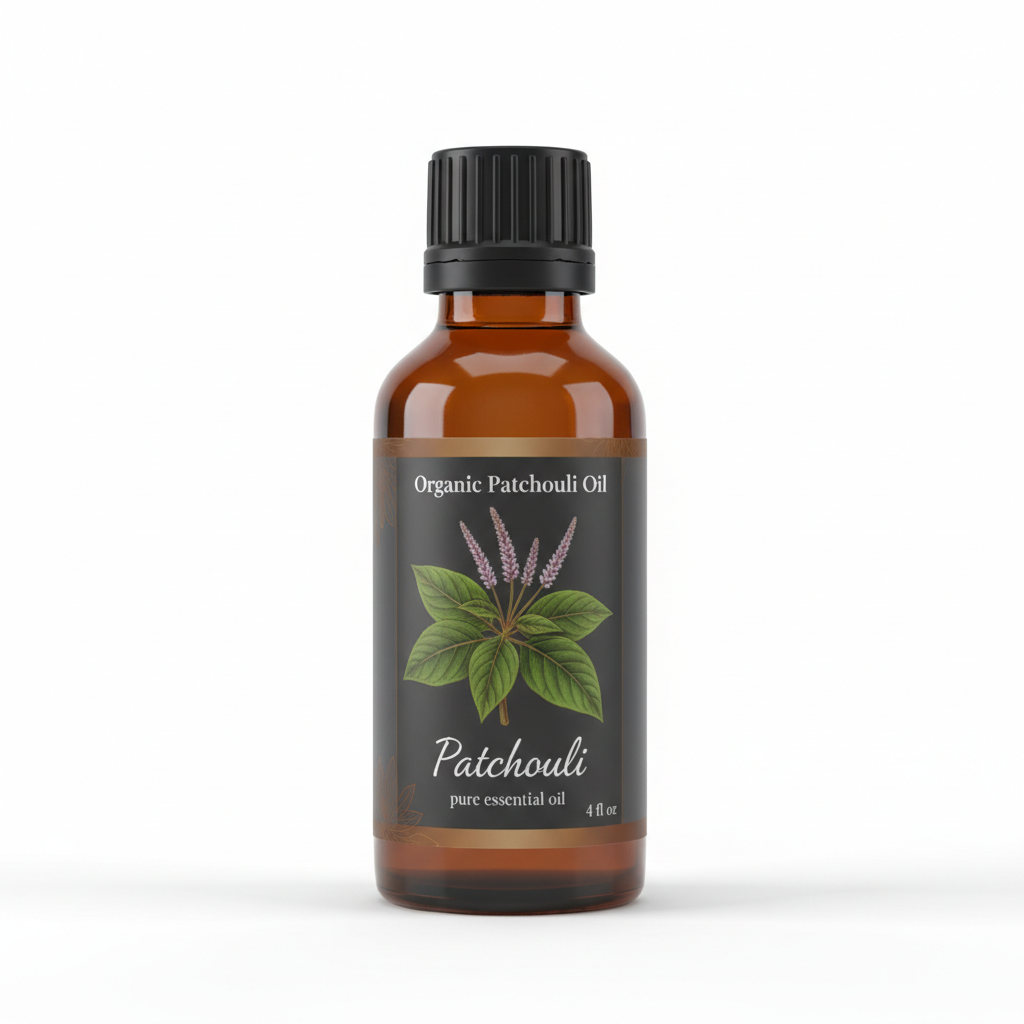
Patchouli Essential Oil
Our own Patchouli Essential Oil, in sizes from 0.5 oz to bulk.
From $20.99
Shop Now →Start with the flakes
The NHS advises an anti-dandruff shampoo containing ketoconazole, coal tar or salicylic acid, used for up to four weeks, and says you may need to try a different type if one does not help. It suggests seeing a GP if symptoms persist after at least four weeks of shampoo, if dandruff is severe or very itchy, if the scalp is red or swollen, or if you have flaky, itchy patches on your face or body. The American Academy of Dermatology adds that dandruff shampoos can manage mild to moderate seborrheic dermatitis of the scalp, sometimes as the only treatment needed, and that a board-certified dermatologist can confirm the diagnosis.
So the order that works is: work out what is going on, use a product with a real track record, and see a professional if it doesn't clear. Scent comes last.
What the rulebook recognises
In the United States, the FDA's over-the-counter rule for dandruff products (21 CFR 358.710) lists the active ingredients it recognises: coal tar, pyrithione zinc, salicylic acid, selenium sulfide and sulfur, each within a stated percentage range. Patchouli oil is not on the list, and neither is any other essential oil. The FDA also explains that a product's intended use, shown by claims on its label, advertising and website, decides whether it is a cosmetic or a drug. A dandruff claim makes an oil a drug, which is why ours carries none: we sell a patchouli essential oil for aroma and cosmetic use.
What the fungus papers show
Dandruff is usually discussed in connection with the yeast Malassezia. Patchouli has no study against it yet. There is, however, laboratory work on other microbes. A 2013 paper in the Bangladesh Journal of Microbiology tested patchouli oil against ten bacteria and six fungi using agar wells and broth dilution, with ampicillin and nystatin as comparison drugs. The oil showed moderate activity on all the fungi: a 16 mm inhibition zone against Candida albicans (the lowest concentration that stopped it was 750 micrograms per ml) and the lowest filamentous-fungus concentration, 250 micrograms per ml, against Aspergillus fumigatus.
It is a useful paper, and it shows that patchouli oil inhibits certain fungi in a dish. It cannot tell us whether the oil reaches yeast on a scalp, whether it survives inside a shampoo, whether skin tolerates the strength it would need, or whether flaking improves. A micrograms-per-millilitre figure in a dish is not a percentage you can put on a head.
Tea tree shows what a real test looks like
One essential oil does have a dandruff trial, and it makes a useful contrast. In 2002, Satchell and colleagues randomised 126 people aged 14 and over with mild to moderate dandruff to a 5% tea tree oil shampoo or a placebo shampoo for four weeks. Severity improved by 41% with tea tree oil and 11% with placebo, itchiness and greasiness scores improved, scaliness did not reach significance, and no adverse effects were reported. An American Family Physician summary of the trial points out that the oil's strong smell may have let participants guess which group they were in. None of this concerns patchouli. It simply shows that a real test needs a stated strength, a comparison group and a clinical score. If you are weighing the two oils for other purposes, our patchouli versus tea tree comparison goes through them side by side.
The scent people reach for in hair oils
It is easy to see why patchouli turns up in hair oils. It is deep, earthy and long-lasting, and it gives a hair or beard oil a signature that people remember. A drop or two goes a long way, so there is no need to be generous. If you are blending your own, smell the finished oil in the bottle first, then on your hand, before you take it near your head.
Patchouli near your hair, sensibly
A flaky, itchy scalp may already be irritated, and irritated skin is less tolerant of fragrance. A European safety assessment classes patchouli oil as an irritant to skin and eyes and as a dermal and respiratory sensitiser. Our guidance for skin is 0.5% to 2% in a carrier oil with a patch test first, and for anything left on the scalp we suggest the lower end, 0.5% to 1%. If your scalp is red, raw, swollen or oozing, leave patchouli out until a clinician has looked at it.
For one ounce (29.57 ml) of carrier, the arithmetic at about 20 drops per ml comes to roughly 3 drops for 0.5%, 6 drops for 1% and 12 drops for 2%. Try a forearm patch first and then a small scalp area, and wait before using more widely. Our carrier oil guide helps with the base, and the dilution chart has the full table. If you love the aroma of patchouli in a hair oil, a few drops of a well-diluted blend is plenty.
Patchouli has plenty to offer as a rich, grounding scent. For a flaky scalp, the sensible route is a proven shampoo and a conversation with a pharmacist or dermatologist, with patchouli kept as a pleasure.
Patchouli Essential Oil
Patchouli Essential Oil from our own shop, in sizes from 0.5 oz to bulk.
From $20.99
Shop Now →Sources & Further Reading
- NHS. Dandruff - NHS. www.nhs.uk/conditions/dandruff/
- American Academy of Dermatology. Seborrheic dermatitis: Diagnosis and treatment. www.aad.org/public/diseases/a-z/seborrheic-dermatitis-treatm
- LII. 21 CFR 358.710 - Active ingredients for the control of dandruff, seborrheic dermatitis, or psoriasis. www.law.cornell.edu/cfr/text/21/358.710
- FDA. Is It a Cosmetic, a Drug, or Both? (Or Is It Soap?). www.fda.gov/cosmetics/cosmetics-laws-regulations/it-cosmetic
- Das P et al., 2013. Antibacterial and Antifungal Activity Analysis of Essential Oil of Pogostemon cablin (Blanco) Benth. Bangladesh Journal of Microbiology 30. www.banglajol.info/index.php/BJM/article/view/28446
- Satchell AC et al., 2002. Treatment of dandruff with 5% tea tree oil shampoo. J Am Acad Dermatol. pubmed.ncbi.nlm.nih.gov/12451368/
- American Family Physician, 2003. Tea Tree Oil Shampoo in the Treatment of Dandruff. www.aafp.org/pubs/afp/issues/2003/0501/p1985.html
- EFSA FEEDAP Panel, 2025. Safety and efficacy of a feed additive consisting of an essential oil derived from the leaves of Pogostemon cablin Benth. (patchouli oil) for use in all animal species (FEFANA asbl). pmc.ncbi.nlm.nih.gov/articles/PMC12004087/