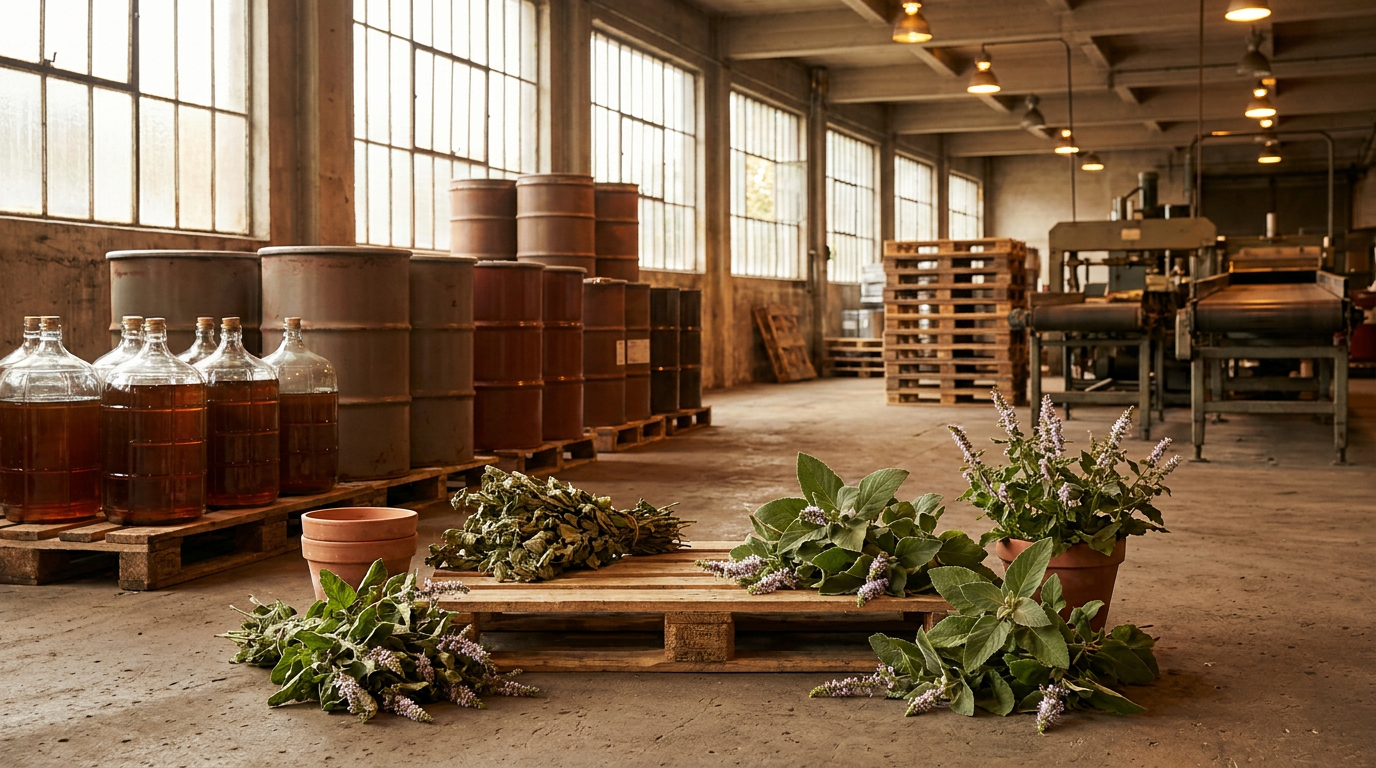
Patchouli is the base note that soap, candle, and perfume makers reach for when a blend needs weight and staying power. This guide covers what separates a genuine batch of steam-distilled Pogostemon cablin from a cut or synthetic substitute, and how wholesale buyers order it by the pound instead of the drop.
See wholesale pricing for every size, from 0.5 oz to 400 lbs, on the bulk order page.
Patchouli oil comes from Pogostemon cablin, a bushy mint-family plant grown mainly in Indonesia and India. The leaves are cut, shade-dried for several days, and left to ferment lightly before they ever reach the still; that fermentation step is what gives patchouli its dark, wine-like depth instead of a flat green smell. How the oil moves from fermented leaf to iron still covers the distillation side in detail, and it matters for wholesale buyers because the still material itself is part of what separates traditional dark oils from newer light ones.
Freshly distilled patchouli is thin and sharp, almost green. Left in the barrel or the bottle, it rounds out and deepens, the same oil turning noticeably smoother and darker with no change to the plant it came from. Dark patchouli versus light patchouli lays out how still material and aging time produce two genuinely different products from the same crop, and the price guide to grades and aging is the fastest way to sanity check a wholesale quote against what that grade should actually cost.
Organic certification adds a paper trail back to the farm and the processor, which is worth confirming before a large order rather than after. Whether organic certification is worth paying for and how to read a patchouli label both walk through what a legitimate supplier discloses: botanical name, origin, extraction method, and often the still material and approximate age of the batch.
| Sold as | What it actually is | How to recognize it |
|---|---|---|
| Light or "green" patchouli oil | Oil sold soon after distillation, before it has had time in the barrel or bottle to round out | Sharper, brighter top note and a paler amber color, often priced lower than aged stock |
| Dark or aged patchouli oil | The same distillate after extended time in barrels or sealed glass, which mellows the sharp edge and deepens the color and aroma | Deep amber to brown color, a smoother wine-like nose with less bite, usually the higher-priced option |
| Patchouli fragrance oil | A lab-built reconstruction meant to mimic the scent, not an extract of the plant at all | No botanical name on the label, an ingredient list that reads like a chemical formula, and a scent that is identical bottle to bottle in a way real crop-based oil never is |
| Cut or stretched patchouli oil sold as pure | Genuine patchouli oil diluted with a carrier oil or solvent and sold at full-strength pricing | Thin texture, a weak aroma even at a normal dose, and a seller who cannot produce a current Certificate of Analysis |
Buyers who plan to formulate rather than resell should treat aroma and documentation as two separate checks. Quality checks worth running before you pay covers both.
The real sourcing trap in this category is not a bad patchouli oil, it is a fragrance oil or a cut batch sold with patchouli language on the label. Ask for the botanical name, the extraction method, and a current Certificate of Analysis before wiring money for a drum-size order.
Wholesale demand for patchouli concentrates in a handful of trades that all lean on it as a base note or a fixative rather than a headline scent. Cold-process soap makers use it to anchor a bar's fragrance so the top notes do not fade during the cure. Candle makers reach for it to give a fragrance blend lasting throw. Independent perfumers and incense makers buy it because almost nothing else in the natural palette does the same job of holding a composition together at the base.
A smaller but steady slice of demand comes from grooming and personal-care brands, beard oil, solid perfume, and body oil makers, who use patchouli for its own earthy identity rather than as a fixative. The wholesale buyer's guide for soap and candle makers is written for the first two groups specifically; the application guides below cover the rest.
Before placing a bulk order, confirm the following on paper, not just on the label.
Our own batch documentation is published, not something you have to request and wait on: see the Certificate of Analysis before you order.
Patchouli oil is unusual among essential oils in that buying more than the next batch needs is a reasonable strategy, since the oil improves with time in the bottle rather than degrading. How to store patchouli oil covers the aging side in more depth. For sourcing decisions, the sizes below map roughly to where a buyer sits: sample bottles for formulation testing, mid sizes for a production run, and the pound tiers for standing wholesale supply.
Which size to order first is a useful cross-check if the volume below still feels like a guess.
Order a 0.5 oz or 1 oz bottle and run it through an actual batch, not just a smell test on a strip, since patchouli reads differently in a finished product than it does alone.
Request the Certificate of Analysis for the specific lot you would be buying, not a general sample, before committing to a pound-tier order.
Move to the 5 lbs or 25 lbs tier once the formula is locked, and hold back a small amount of the sample lot to compare against the new shipment on arrival.
Standing wholesale accounts typically settle into the 100 lbs or 400 lbs tier on a repeat schedule; ask about lot consistency across repeat orders before locking in a cadence.
The application guides below break down what each category of bulk buyer actually needs from a patchouli supplier.
Cold-process and melt-and-pour soap makers use patchouli as a base note that survives the cure and holds a bar's scent for months on the shelf.
Read the sourcing guide →Candle makers add patchouli to a wax blend for depth and lasting throw, especially in fall and winter fragrance lines.
Read the sourcing guide →Independent and small-batch perfumers buy patchouli as a base note and fixative that holds a composition together from open to dry-down.
Read the sourcing guide →Incense and room-mist makers use patchouli for its heavy, lingering base, often paired with resins and woods.
Read the sourcing guide →Grooming brands use patchouli's earthy, woody character as a signature note in beard oil and other men's grooming products.
Read the sourcing guide →Body oil and solid perfume makers use patchouli as a long-wearing base note that anchors a skin-safe fragrance blend.
Read the sourcing guide →Home fragrance brands use patchouli to give reed diffusers and blended oils a base that lasts as long as the bottle does.
Read the sourcing guide →Our team can talk through grade, lot documentation, and lead times: get in touch.