Patchouli Oil and Acne: What Lab Studies Show
Search for patchouli and acne and you will find the same sort of sentence over and over: patchouli oil fights acne bacteria. It is worth looking at where that sentence comes from, because the studies behind it are genuinely interesting, and they are also all done in laboratory dishes, not on people.
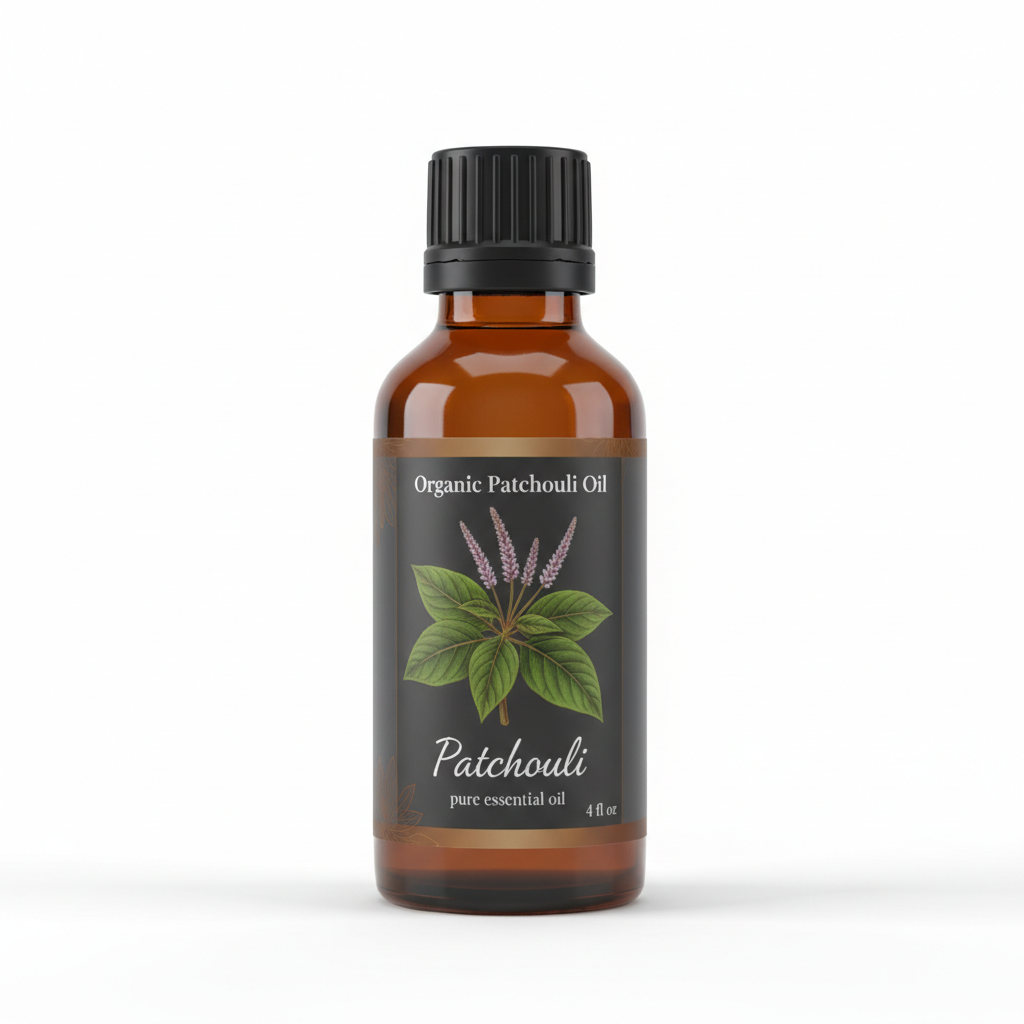
Patchouli Essential Oil
Our own Patchouli Essential Oil, in sizes from 0.5 oz to bulk.
From $20.99
Shop Now →Three lab papers worth knowing
A 2020 Thai study mixed citronella, lemongrass and patchouli oils and tested them against two bacteria associated with acne, Propionibacterium acnes (now called Cutibacterium acnes) and Staphylococcus epidermidis, in liquid culture. Patchouli was the most active of the three on its own, but too much of it in a blend made the mix less effective. The best blend, citronella, lemongrass and patchouli at 1:2:1 by weight, stopped growth at 0.3125 mg/ml for P. acnes and 0.625 mg/ml for S. epidermidis.
A 2018 screen tried 408 two-oil combinations against the same two bacteria. Patchouli was among the oils that contributed most to the combinations with noteworthy activity, and three combinations worked synergistically against P. acnes. The authors noted that none of those pairings matched the combinations recommended in popular aromatherapy writing, and concluded that claims need scientific validation.
A 2026 study went a step further. It profiled a patchouli oil by GC-MS (mostly alpha-guaiene, patchouli alcohol and alpha-bulnesene), found it stopped bacterial growth at 0.50 mg/ml and disrupted bacterial membranes, and then used two cell lines in a dish: a mouse immune-cell line and human keratinocytes challenged with heat-killed C. acnes. Inflammatory signals called TNF-alpha, IL-1 beta and IL-6 were lower in both. That is a nice piece of cell biology and a good reason for the question to be studied further.
Why a plate is not a face
A minimum inhibitory concentration, or MIC, is simply the lowest concentration that stops visible bacterial growth in a liquid. As a scale check only, 0.50 mg/ml works out to 0.05%, which is far below our own 0.5% to 2% dilution guidance (0.5% is 5 mg/ml). That comparison does not make it a dose. In a broth the oil is stirred through the liquid and the bacteria sit in it. On skin the oil mixes with sebum and a carrier, evaporates, and has to reach bacteria living inside follicles.
Lab methods have limits as well. A methods review in the Journal of Pharmaceutical Analysis notes that the disk diffusion test used in many oil studies cannot tell killing from slowing growth. And a cell line in a dish challenged with dead bacteria is a step closer to skin biology, though still not a person. Together these papers say the question is worth asking, which is different from saying the question is answered.
How to read a headline about essential oils
When you see "study shows" next to an oil, a few quick questions will keep you grounded. Was it done in a dish or on people? What concentration was used, and could anyone realistically use it? Who ran the work, and has anyone repeated it? Most headlines skip all three. Getting into the habit of asking them makes every article about every oil easier to read, ours included.
What dermatologists point to
The American Academy of Dermatology's 2024 acne guideline makes 18 evidence-based recommendations. Strong recommendations cover benzoyl peroxide, topical retinoids, topical antibiotics and oral doxycycline, and oral isotretinoin for severe acne. Conditional recommendations include clascoterone, salicylic acid and azelaic acid. Essential oils do not appear in the recommendations the abstract lists. For everyday information the NHS acne page is a clear starting point, and a pharmacist or GP is the person to ask about spots that are painful, widespread or scarring.
There is a regulatory reason we stay out of this territory too. In the United States, the FDA decides whether a product is a cosmetic or a drug by its intended use, shown through labels and claims, and acne cleansers are an example of products it regulates as drugs. We sell a patchouli essential oil for aromatic and cosmetic use, so we describe its scent and leave skin conditions to the professionals.
If you love the scent on your skin
Patchouli's rich, earthy aroma is a fine reason to want it in a leave-on blend. We sell it neat, so dilute it first: our guidance is 0.5% to 2% in a carrier oil, with a patch test first. A European safety assessment classes patchouli oil as an irritant to skin and eyes and as a dermal and respiratory sensitiser, so we start at the lower end, 0.5% to 1%, for anything leave-on. Breakouts and irritated skin are not the moment to introduce a new fragrance. Our article on allergy and patch testing explains how to test sensibly, and patchouli versus tea tree puts two popular oils side by side. For carrier choices, see best carrier oils for patchouli.
A gentler way to enjoy the scent
If you love the smell, there are ways to enjoy it that keep it away from your face. A drop on a cotton pad in a dish across the room gives you the deep, earthy aroma without touching skin. Leave your skincare routine to the pharmacist or dermatologist who knows your skin, and think of patchouli as the pleasant part of your day.
Keep the bottle capped and away from children and pets. Patchouli has plenty to offer as a base note without having to be a skincare answer.
Patchouli Essential Oil
Patchouli Essential Oil from our own shop, in sizes from 0.5 oz to bulk.
From $20.99
Shop Now →Sources & Further Reading
- Bunrathep S et al., 2020. Effect of an essential oil blend of citronella, lemongrass,and patchouli on acne-causing bacteria. Songklanakarin Journal of Science and Technology 42(5). doi.nrct.go.th/ListDoi/listDetail/10.14456%2Fsjst-psu.2020.1
- Orchard A et al., 2018. The in vitro antimicrobial evaluation of commercially essential oils and their combinations against acne. International Journal of Cosmetic Science. pubmed.ncbi.nlm.nih.gov/29574906/
- Cui J et al., 2026. Antibacterial, In Vitro Anti-Inflammatory and Anti-Acne Activities of Patchouli Essential Oil. Pharmaceuticals. pubmed.ncbi.nlm.nih.gov/42356504/
- Balouiri M et al., 2016. Methods for in vitro evaluating antimicrobial activity: A review. Journal of Pharmaceutical Analysis. pmc.ncbi.nlm.nih.gov/articles/PMC5762448/
- Reynolds RV et al., 2024. Guidelines of care for the management of acne vulgaris. Journal of the American Academy of Dermatology. pubmed.ncbi.nlm.nih.gov/38300170/
- NHS. Acne. www.nhs.uk/conditions/acne/
- FDA. Is It a Cosmetic, a Drug, or Both? (Or Is It Soap?). www.fda.gov/cosmetics/cosmetics-laws-regulations/it-cosmetic
- EFSA FEEDAP Panel, 2025. Safety and efficacy of a feed additive consisting of an essential oil derived from the leaves of Pogostemon cablin Benth. (patchouli oil) for use in all animal species (FEFANA asbl). pmc.ncbi.nlm.nih.gov/articles/PMC12004087/