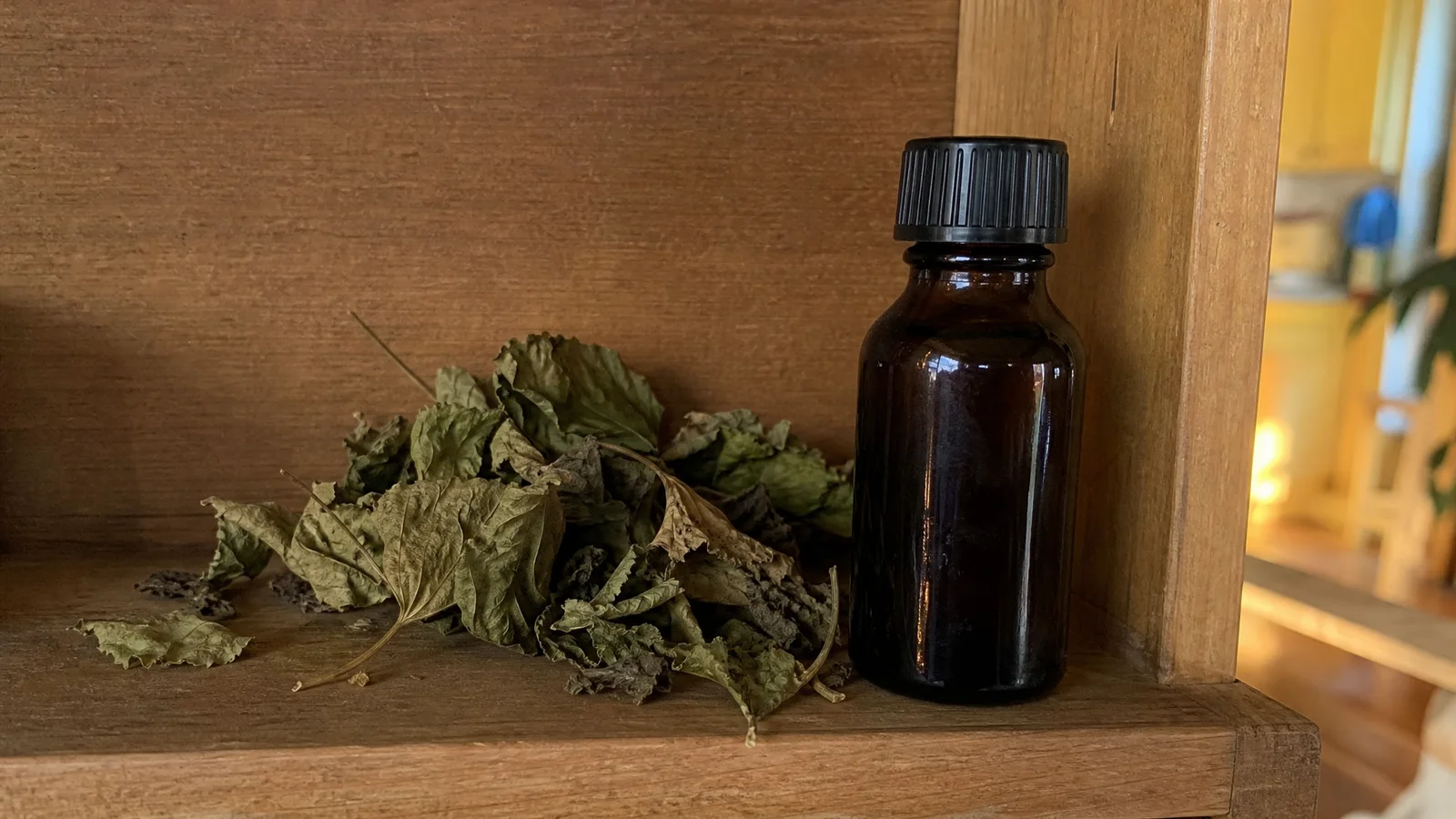
How to Get Patchouli Smell Out of Clothes, Skin and Rooms
Patchouli is built to stay put. Perfumers choose it precisely because it lingers, which is wonderful on a scarf you love and less wonderful on a shirt you did not mean to scent. The good news is that a smell that is really an oil film responds to the right approach, and the first few minutes matter more than anything you do on day three.
Patchouli Essential Oil
Our own Patchouli Essential Oil, in sizes from 0.5 oz to bulk.
From $20.99
Shop Now →Why it clings
PROSEA, the plant-resources reference, says patchouli oil is almost universally used as a fixing agent in perfumery, mostly in very small doses. A fixative holds a scent in place, which is exactly why patchouli sticks around. A review of the plant also credits it with a strong base and lasting character. Our own advice follows from that: one drop too many lingers on skin and cloth for days, and the oil will stain a light surface and does not wash out of pale cloth easily. Since it behaves like a thin film of oil, it needs something that lifts oil, not a stronger scent on top.
Size the job first
A drop is about 0.05 ml, using a rough 20 drops to the milliliter, and weighs roughly 0.05 g if you take the 0.950 to 0.975 density range stated on our Certificate of Analysis. A drop or two is a small spot job. A 0.5 oz bottle emptied is about 15 ml, and a 1 oz bottle about 30 ml. For a larger spill, blot as much as you can with paper or cloth before anything else, because every gram you lift is a gram the detergent does not have to handle. For a big spill on carpet or a mattress, a professional cleaner can tell you what the material tolerates.
Clothes, in order
This sequence is reasoning from how oil behaves rather than a lab method, so always check the care label and test a hidden hem.
- Hold off on heat. Heat can set a mark you could still have removed. Hang the garment while you work, and see our laundry article for why oily cloth and a hot dryer do not mix.
- Blot, then pretreat with liquid dish detergent. It is made to emulsify grease. Skip it on wool or silk unless the label allows.
- Wash as warm as the label permits, then wash a second time if the smell is still there. A stubborn garment often needs the repeat.
- Air dry, ideally in a breeze, and sniff before any heat goes near it.
Avoid rubbing the oil in, and avoid bleach on silk or wool.
Skin
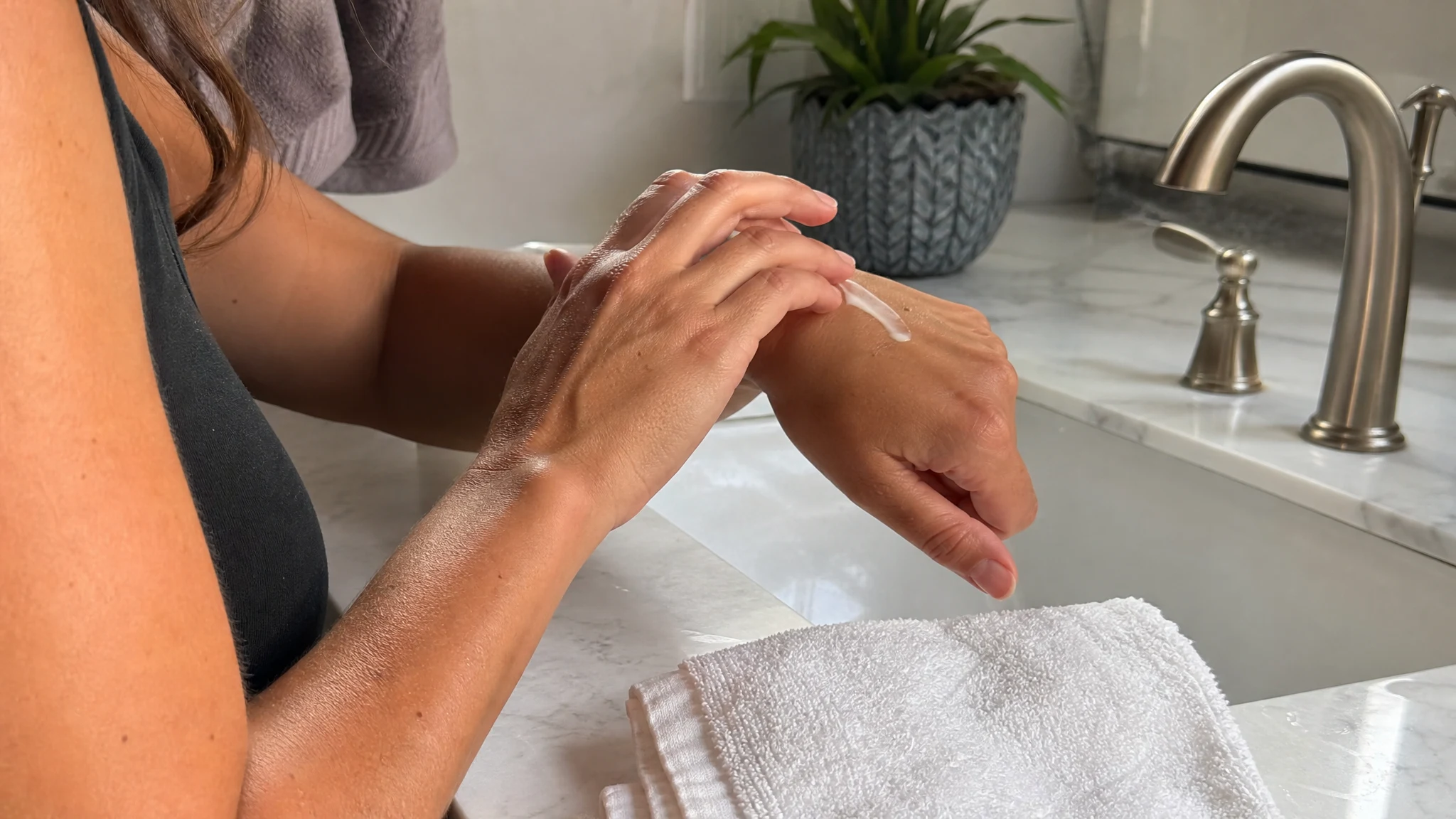
Wash with soap and water as soon as you notice it, without scrubbing. Poison Control advises stopping a product and washing it off gently if a rash appears, and the European Food Safety Authority's panel considered the patchouli oil it assessed to be a skin and eye irritant and a dermal sensitiser. If redness or itching follows, stop using it and ask a physician or pharmacist. Keep it away from eyes, as our label says. If you have been handling the oil, assume your hands and cuffs carry it: wash up, change a shirt that took a splash and keep it apart from clean laundry until it has been washed.
Rooms
Open windows first and remove the source: a soaked cloth, a leaking bottle, a diffuser reservoir. Wipe hard surfaces with warm water and dish detergent rather than more scent. For lingering odor in the air, the EPA says that to filter gases you can choose a portable air cleaner with an activated carbon filter or another filter designed to remove gases, and that these can work when a large amount of filter material is used, "the thicker the better". A thin carbon pad will do little. Please skip ozone generators. The EPA states that at concentrations that meet public health standards, ozone is not effective at removing many odor-causing chemicals.
A few things that make life easier
Work in daylight if you can, so you can see where the oil has spread. A spot of patchouli on a pale shirt often looks like a faint shadow, and it is easier to catch early than to spot once it has dried. Keep a paper towel or an old cloth next to your workspace before you open a bottle, so that blotting is the first reflex and not an afterthought.
Be patient with the nose, too. After a few minutes around patchouli your sense of smell adapts, and a room can seem fine to you while a visitor walking in notices it right away. Step outside for a minute, then come back and sniff again, or ask someone else to check.
And if the smell turns out to be one you actually like on a favorite scarf, it may not need fixing at all. Hang it in fresh air for a day and see how it settles.
Prevention is easier
Cap the bottle before reaching for anything else and stand it on a tray you can wash. Measure in drops, not pours: for reference, 0.5% to 2% in one ounce (29.57 ml) of carrier works out to about 3 to 12 drops, and our dilution chart has the rest. If it is the scent itself that divides your household, our piece on what patchouli smells like explains why some noses love it and others recoil, and a bottle that has had a year to mature is smoother than a fresh one.
The fastest cure is the first five minutes: blot, detergent, warm wash, repeat, hang.
Patchouli Essential Oil
Patchouli Essential Oil from our own shop, in sizes from 0.5 oz to bulk.
From $20.99
Shop Now →Sources & Further Reading
- Pogostemon (PROSEA), Pl@ntUse
- A Comprehensive Review on the Phytochemical Constituents and Pharmacological Activities of Pogostemon cablin Benth.: An Aromatic Medicinal Plant of Industrial Importance, Molecules 2015
- Safety and efficacy of a feed additive consisting of an essential oil derived from the leaves of Pogostemon cablin Benth. (patchouli oil) for use in all animal species (FEFANA asbl), EFSA Journal 2025
- Essential oils: Poisonous when misused, Poison Control
- Guide to Air Cleaners in the Home, US EPA
- Ozone Generators that are Sold as Air Cleaners, US EPA