Growing Patchouli at Home: Leaves, Cuttings, Care
Brush the leaf of a patchouli plant and the scent arrives at once: earthy, sweet, a little spicy. It is one of the great pleasures of growing it. It is also the best case for growing it for its leaves rather than for oil, because the arithmetic of making oil at home is humbling.
Patchouli Essential Oil
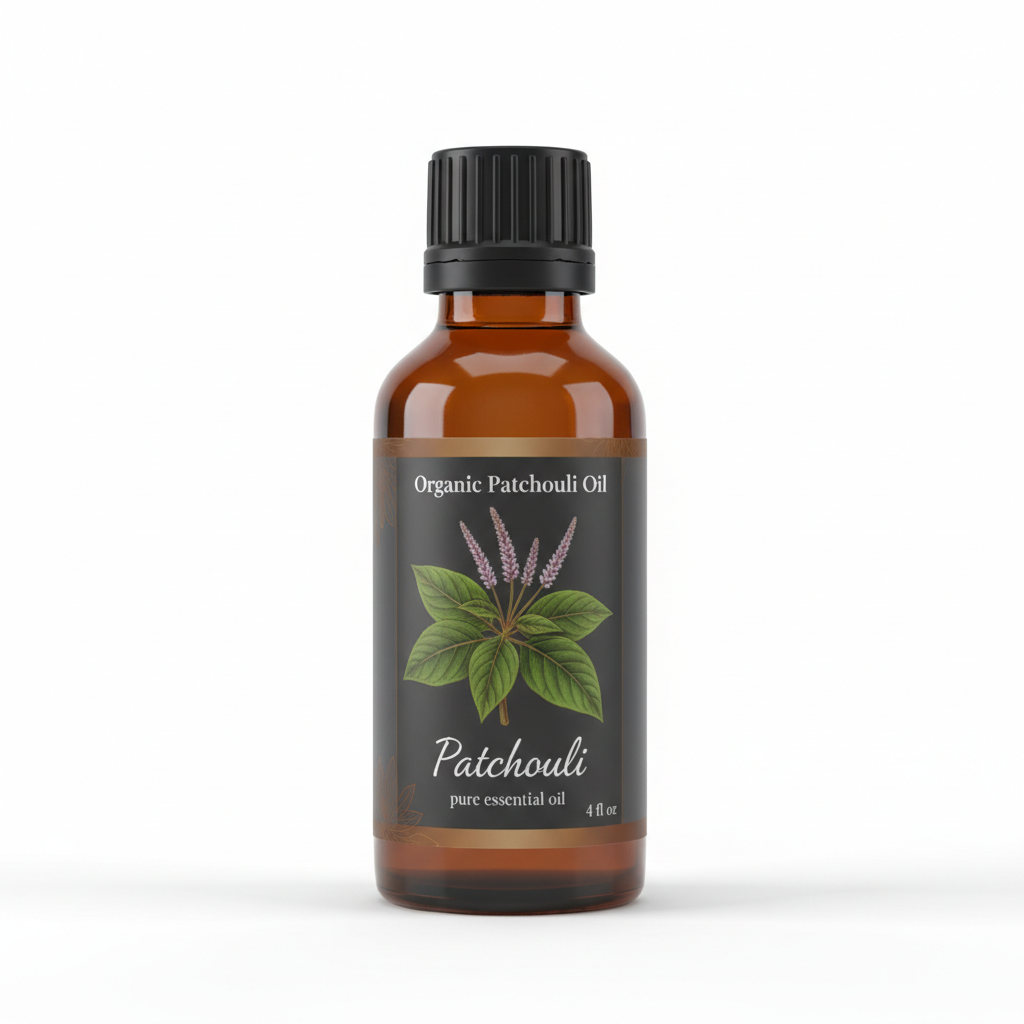
Our own Patchouli Essential Oil, in sizes from 0.5 oz to bulk.
From $20.99
Shop Now →The plant itself
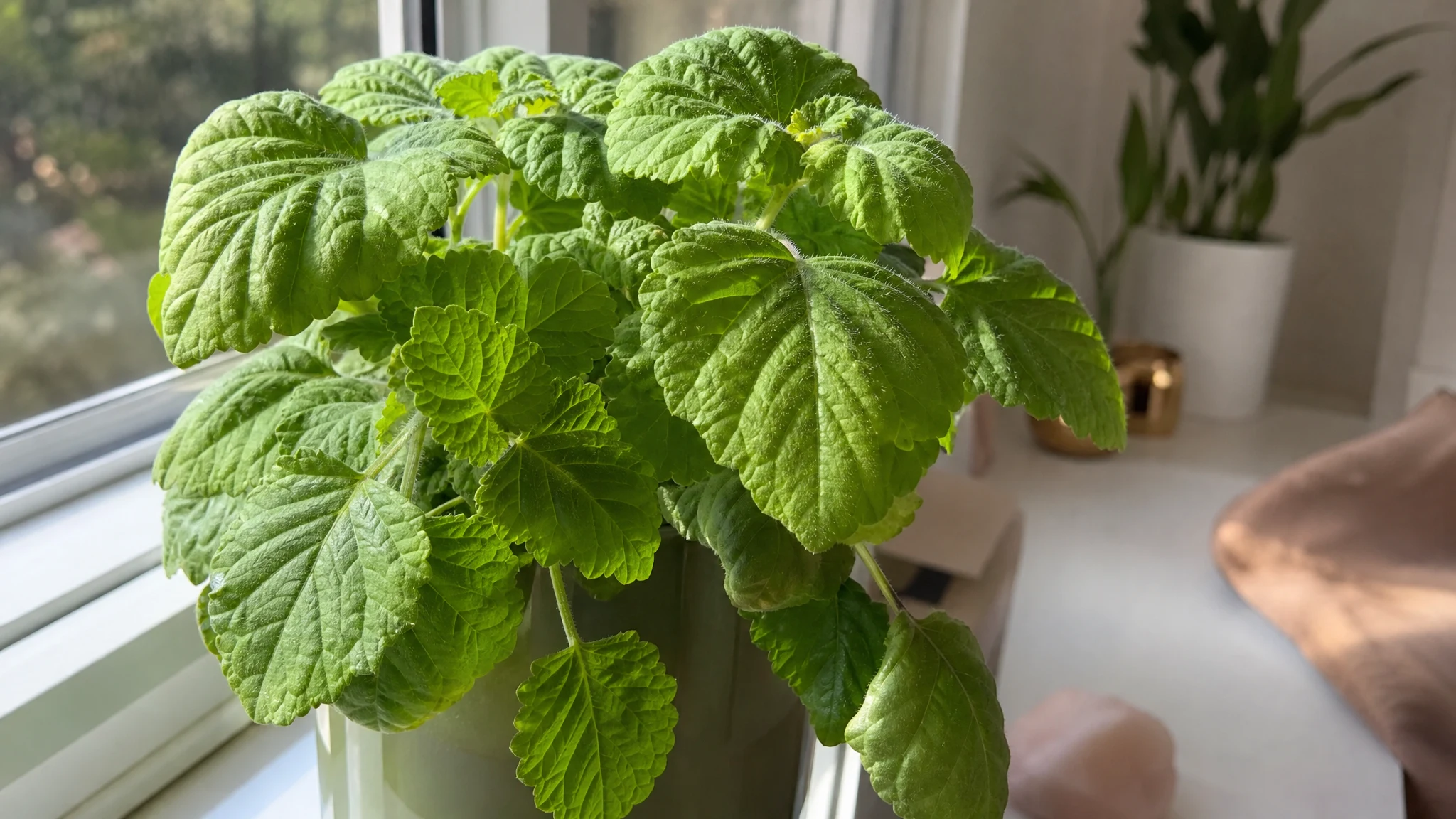
Patchouli, Pogostemon cablin, belongs to the mint family. PROSEA, the plant resources reference for South-East Asia, describes an erect, aromatic herb with opposite, ovate leaves. It notes that in cultivation it rarely flowers, so growers propagate it vegetatively by cuttings rather than seed. That makes it a generous plant to share: a cutting from a friend's pot will root.
The leaf is where the value sits. Swamy and Sinniah's review reports the oil is held in glandular hairs on the leaf, and quotes a comparison from Guangdong in which leaf oil held 37.53% patchoulol against 10.26% in stem oil. It is one sample pair, not a rule, but it explains why growers strip and dry the leaf. The same review notes the plant is native to the Philippines, and a separate study describes two chemotypes, one rich in patchoulol and one in pogostone, so two plants sold as patchouli can differ in both smell and chemistry.
What it likes
PROSEA describes a tropical plant. It gives an average temperature of 22 to 28 C and says a minimum monthly average humidity of 75% is considered essential for sustained growth in Indonesia. It is not described as frost tolerant. Tamil Nadu Agricultural University suggests well-drained, slightly acidic loam. Our practical reading of those needs is this: grow it in a pot with a fast-draining mix, give it warmth and some humidity, and bring it indoors before frost. PROSEA also reports that shade is tolerated and that waterlogged soil is hard on young plants.
Cuttings and harvest
For Indonesian practice, PROSEA describes cuttings of 5 to 10 cm taken from semi-mature stems and rooted in a nursery before planting out. Commercial crops are first cut at about 6 to 8 months and then every few months. For a pot grower, that translates into pinching back to keep the plant bushy and using the trimmings as leaf to dry.
Living with the plant
Part of the joy is that a patchouli plant is easy to enjoy at close range. Put the pot where you will brush past it, beside a doorway or at the end of a bench, and each pass releases a little of that earthy, sweet scent. Rub a leaf between your fingers and the aroma stays on your skin for a while, so you may find yourself sniffing your hands later in the day. The leaves feel slightly soft and fuzzy, which makes them pleasant to handle.
As a practical matter, give the pot a saucer you can empty, water when the top of the soil feels dry, and avoid leaving the roots sitting in water. If the plant gets leggy, pinch the tips and dry what you take. A bushier plant gives you more leaf to use.
The honest arithmetic of oil
PROSEA says a hectare in Indonesia yields 40 to 60 kg of patchouli oil. If plants stand about 60 cm apart each way (our assumption, giving roughly 27,800 plants per hectare), that works out to around 1.4 to 2.2 g of oil per plant per year. Ten pots on a sunny patio might theoretically make 14 to 22 g, and that assumes every plant performs like a field crop and every gram is recovered.
The leaf needed is also considerable. Givaudan's technical brief gives roughly 50 kg of dry leaf per kilogram of oil, so 14 g of oil would need about 0.7 kg of dry leaf. PROSEA describes steam distillation runs of 6 to 8 hours on charges of 75 to 100 kg. Small-scale recovery is not something these sources address, so we would not promise it. Distillation is a commercial craft, and we leave it to the people who do it every day.
What to do with your leaf
PROSEA says leaves are dried for 2 to 5 days, preferably in shade with good airflow, and that over-drying in strong sun or heat makes them brittle with oil loss. Above 40 C in Malaysian trials the oil loss was around 80%. So skip the oven. Dry your leaf on a rack in the shade, store it whole in a closed jar and crush a little whenever you want the smell. It makes a lovely, simple sachet for a drawer.
If you are curious how the commercial route works, we describe it in how patchouli oil is made, and the general profile is in what patchouli oil is. For how origin shapes the oil, see Indonesian and Indian patchouli.
Cuttings are the friendliest way to begin. Many gardeners start them in a glass of water or in a damp, gritty mix, and either way they like warmth and bright light that is not harsh midday sun. Once a cutting has a good set of roots, pot it up, and you will have a plant to give away to the next person who falls for the smell. Patchouli is one of those plants that people pass along.
Grow the plant for its leaf, enjoy the scent when you brush past it, and leave the still to the professionals.
Patchouli Essential Oil
Patchouli Essential Oil from our own shop, in sizes from 0.5 oz to bulk.
From $20.99
Shop Now →Sources & Further Reading
- Pogostemon (PROSEA) - Pl@ntUse. plantuse.plantnet.org
- Swamy MK, Sinniah UR, 2015. A Comprehensive Review on the Phytochemical Constituents and Pharmacological Activities of Pogostemon cablin Benth.: An Aromatic Medicinal Plant of Industrial Importance. Molecules. PMC6272783
- Zhang C et al., 2019. The plastid genome and its implications in barcoding specific-chemotypes of the medicinal herb Pogostemon cablin in China. PLoS One. PMC6464210
- Tamil Nadu Agricultural University. Horticulture :: Aromatic Crops :: Patchouli. agritech.tnau.ac.in
- Givaudan. Patchouli technical brief. givaudan.com/files/giv-tb-patchouli-pdf