Does Patchouli Scent Reduce Stress? What Studies Say
Patchouli's smell is a favourite with plenty of people, and that is a lovely reason to enjoy it. What it is not is a treatment for anxiety, and we are careful to say so: we sell an aromatic and cosmetic oil, not a product for anxiety or stress. If worry is getting in the way of your days, a clinician or licensed therapist is the right person to talk to. Here is what the research on patchouli actually covers, so you can enjoy the scent with a clear picture.
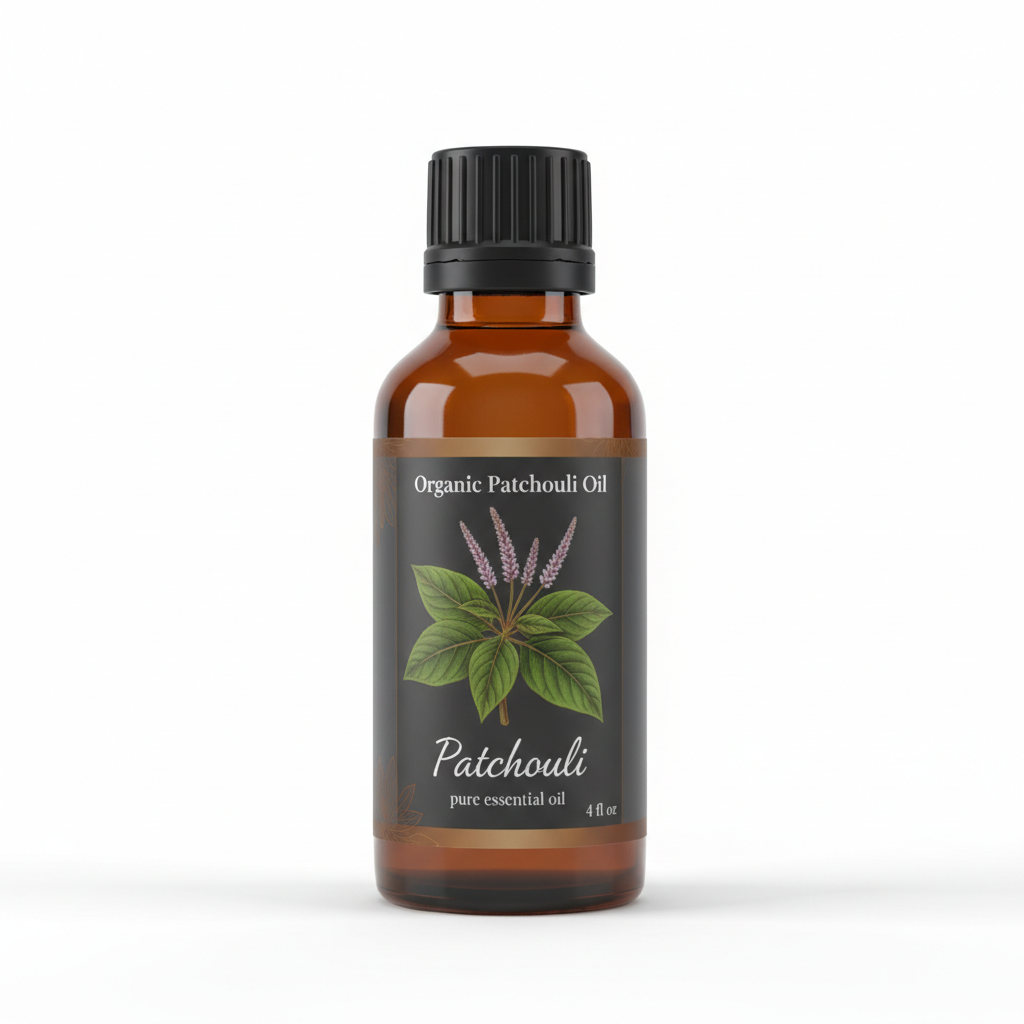
Patchouli Essential Oil
Our own Patchouli Essential Oil, in sizes from 0.5 oz to bulk.
From $20.99
Shop Now →Everyone has a smell that takes them somewhere. For some people patchouli is a record shop, a grandmother's scarf or a market stall, and the memory arrives before they have thought about it. That kind of pull is real and it is a good reason to like a scent. It is a different thing from a treatment, which is the line we try to keep clear in this article.
If anxiety is more than a passing mood
The US National Institute of Mental Health separates anxiety disorders from ordinary worry: for people with these disorders, anxiety "does not go away, is felt in many situations, and can get worse over time". In the United States anyone who is struggling can call or text 988, the Suicide & Crisis Lifeline. In England the NHS advises contacting NHS 111 or a GP when anxiety affects daily life, and its Talking Therapies service takes self-referrals without a GP. The NCCIH makes a similar point about relaxation practices generally, that they should complement and not replace conventional care.
The patchouli studies, in plain English
Three papers come up most often, and each one tested something quite different.
Children at the dentist. A 2023 trial in the International Journal of Clinical Pediatric Dentistry compared lavender and patchouli oils in aromatherapy for 60 children aged 6 to 12 before dental treatment. Anxiety scores and pulse rates fell over the time intervals, and the authors reported lavender did slightly better. The abstract does not describe the delivery method, the oil strength or a no-scent comparison group, which limits what a reader can take from it.
Stressed rats. A 2024 study in Frontiers in Nutrition gave patchouli oil by mouth to rats under chronic mild stress. The animals showed less anxiety-like behaviour in an open-field test, with changes in gut bacteria and hippocampal serotonin. It is a gut-brain study in rodents; the oil was swallowed, which is the opposite of how we say our oil should be used. It was never meant for the mouth.
Healthy adults breathing a scent. A 2002 Japanese study found that smelling patchouli or rose oil lowered a blood-pressure-based marker of sympathetic activity by about 40% compared with an odourless solvent, while oils like pepper and fennel raised it. That tells us scents can nudge body signals in healthy volunteers. It did not measure anxiety.
That is the patchouli-specific record we know of: one small paediatric dental trial, one rat study and one physiology experiment.
What the broader aroma research looks like
A 2023 systematic review in Complementary Therapies in Clinical Practice gathered 76 studies with 6,539 patients on inhaled essential oils in clinical settings. More than 70% of the studies reported a positive effect on anxiety. The authors also found the results too varied to pool, and many studies lacked safety data and gave imprecise details of the plant species and dose. An older review of aromatherapy trials from 2000 concluded the effects were probably not strong enough for aromatherapy to be considered a treatment for anxiety. A 2020 nursing article on clinical aromatherapy lists skin irritation and toxicity if swallowed alongside the potential benefits.
The fair summary is that smelling something pleasant often feels good, that people in these trials can tell what they were given, and that lavender has been studied far more than patchouli. Reasoning from that, enjoy the scent as scent and keep real concerns with a professional.
Making a small ritual of it
If scent is part of how you like to mark the end of a day, you can do it simply. Open the window, put one drop on a cotton pad, and set it on a saucer across the room instead of beside your face. Notice the first minute, when the earthy, wine-like depth is strongest, and the slow change as it fades. Tidy the pad away afterwards. It is a pleasant habit, and it is only as meaningful as you want it to be.
There is also something to be said for variety. If a scent starts to feel heavy, put it aside for a while and come back to it. Liking a smell is not a rule, and your nose will tell you when it is enough.
Enjoying patchouli the sensible way
If you simply love the aroma, it makes a wonderful deep base note. We sell the oil neat, so dilute it before it touches skin; our guidance is 0.5% to 2% in a carrier oil with a patch test first, and never to swallow it. A European safety assessment classes patchouli oil as an irritant to skin and eyes and a dermal and respiratory sensitiser, which is why we start at 0.5% to 1% for leave-on use. If a diffused oil makes you cough or gives you a headache, stop and air the room. Keep the bottle away from children and pets.
For more on what goes well beside patchouli, try our pairing guide, our piece on patchouli in aromatherapy, or patchouli and meditation. Scent can be a small daily pleasure, and it works best as exactly that.
Patchouli Essential Oil
Patchouli Essential Oil from our own shop, in sizes from 0.5 oz to bulk.
From $20.99
Shop Now →Sources & Further Reading
- NIMH. Anxiety Disorders - National Institute of Mental Health (NIMH). www.nimh.nih.gov/health/topics/anxiety-disorders
- NHS. Anxiety - Every Mind Matters - NHS. www.nhs.uk/every-mind-matters/mental-health-issues/anxiety/
- NCCIH. Meditation and Mindfulness: Effectiveness and Safety. www.nccih.nih.gov/health/meditation-and-mindfulness-what-you
- Tripathy S et al., 2023. Comparative Evaluation between Lavender Essential Oil and Patchouli Essential Oil in Aromatherapy and Its Effect on Dental Anxiety in Children. Int J Clin Pediatr Dent. pubmed.ncbi.nlm.nih.gov/38162239/
- Ouyang P et al., 2024. Pogostemon cablin essential oil affects anxiety- and depressive-like behaviors and the gut microbiota in chronic unpredictable mild stress model rats. Front Nutr. pubmed.ncbi.nlm.nih.gov/38419848/
- Haze S et al., 2002. Effects of fragrance inhalation on sympathetic activity in normal adults. Jpn J Pharmacol. pubmed.ncbi.nlm.nih.gov/12499579/
- Hedigan F et al., 2023. Benefit of inhalation aromatherapy as a complementary treatment for stress and anxiety in a clinical setting - A systematic review. Complement Ther Clin Pract. pubmed.ncbi.nlm.nih.gov/37031643/
- Cooke B, Ernst E, 2000. Aromatherapy: a systematic review. Br J Gen Pract. pubmed.ncbi.nlm.nih.gov/10962794/
- Farrar AJ, Farrar FC, 2020. Clinical Aromatherapy. Nurs Clin North Am. pubmed.ncbi.nlm.nih.gov/33131627/
- EFSA FEEDAP Panel, 2025. Safety and efficacy of a feed additive consisting of an essential oil derived from the leaves of Pogostemon cablin Benth. (patchouli oil) for use in all animal species (FEFANA asbl). pmc.ncbi.nlm.nih.gov/articles/PMC12004087/