Patchouli Candles: Fragrance Load, Wax and Wicks
Patchouli and candlelight are a natural pairing: a dark, resinous, woody scent in a warm pool of wax. The part that takes a little care is the number. How much oil goes into a pour is set by the wax, not by the oil, so the best starting point is your wax maker's data sheet. Below is how two real sheets compare and how to turn a percentage into grams.
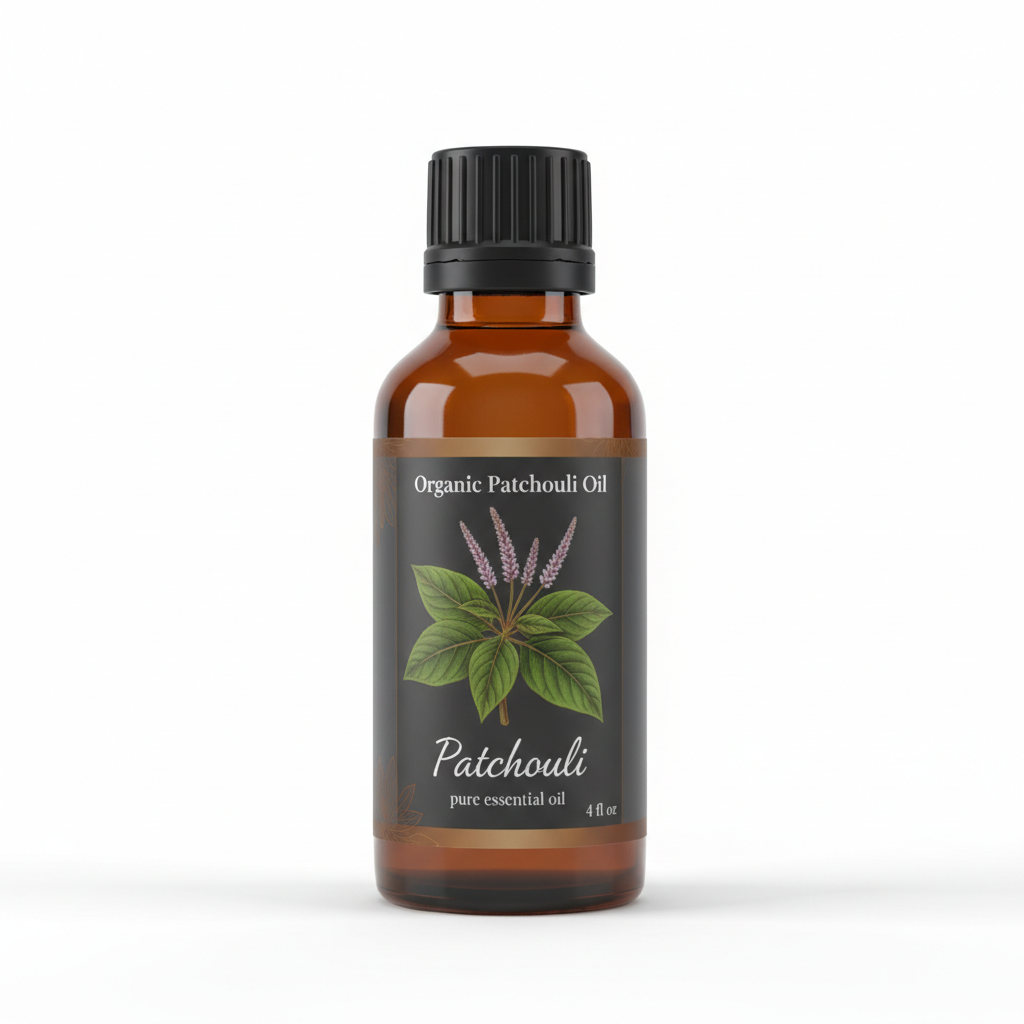
Patchouli Essential Oil
Our own Patchouli Essential Oil, in sizes from 0.5 oz to bulk.
From $20.99
Shop Now →Two wax sheets, two ceilings
A technical data sheet for a soy container wax (version 5.0, revised 26 August 2020) says the wax may be used with fragrance at levels up to 10 to 12%, adds that fragrances developed for natural waxes are highly recommended, and notes that some fragrances may react poorly with the wax, causing bleeding, poor surface finishes or poor flame quality (Technical Data Sheet, Soy Wax Container, version 5.0). A retailer's listing for a different soy wax, S100, gives a maximum fragrance load of 6 to 8% depending on oil potency, a pouring range of 45 to 55 °C and a melting point of 52 °C (London Luxury Candle Supplies, S100 Pure Soy Wax 25kg - 100% Natural Candle Wax).
Neither sheet mentions patchouli. Both speak about fragrance in general, and a thick, intense essential oil may behave differently from the average fragrance oil. Reasoning from the lower ceiling, a first patchouli pour belongs at 6% or below, and the number only rises if your own test burn supports it. Your wax is likely to be neither of these two, so swap in the figures from the sheet that came with yours.
From percentage to grams
Fragrance load here means grams of oil per 100 g of wax, though some suppliers divide by the finished weight, so check how yours defines it. For the oil we use 0.950 to 0.975 g/ml, the standard range printed on the Certificate of Analysis we publish for one batch; it is a stated range and not a measured result, so volumes are given as ranges.
| Load | 200 g wax | 1 kg wax | Oil for 1 kg of wax, in ml |
|---|---|---|---|
| 3% | 6 g | 30 g | 30.8 to 31.6 |
| 6% | 12 g | 60 g | 61.5 to 63.2 |
| 8% | 16 g | 80 g | 82.1 to 84.2 |
A 0.5 oz bottle holds about 14.8 ml, which is roughly 14 to 14.4 g at that density. That covers a 200 g pour at 6% (12 g) with a little to spare. Weigh the oil on a scale; drops vary with the dropper and are a poor guide for a thick oil.
Wax, wick and temperature
We sell the oil, not wax, wicks or containers, so these come from a candle supply shop, where you can ask for the technical data sheet with the recommended fragrance load, pour temperature and wick range for your container. The v5.0 sheet advises that natural waxes tend to need larger wicks than paraffin, that too large a wick can cause sooting and guttering while too small a wick causes tunnelling, and that wicks should be kept trimmed to a quarter inch. It also says to let the wax cool to your pour temperature before adding the fragrance and mixing well, and to wait 48 hours after pouring before a test burn. That means the oil goes into cooled wax, not wax at the top of its melt.
The test burn tells you the rest
Pour a single 200 g candle at 3 to 6% and write down the wick, the load and the temperatures. During the burn, watch the width of the melt pool, any dark build-up on the wick, and whether the container gets uncomfortably hot. If oil sweats onto the surface, lower the load before changing anything else. If the scent seems quiet, the sheet's hint is that wicking has a great effect on throw, so look at the wick before adding more oil.
Patchouli is a deep, slow scent, and we describe it as a base note and natural fixative. It will not announce itself across a room in minutes, and part of its charm is how it settles into a space. Patchouli oil will stain a light surface, so work on something you do not mind losing and wipe drips right away.
One more thing worth saying: patience helps. The 48 hours the data sheet asks for before a test burn is a minimum, and many makers like to wait longer, because a candle judged cold and rested tells you more about the scent than one judged straight from the pour. Write down what you smell cold and what you smell lit, and compare them.
Burning safely
The National Candle Association's rules include trimming wicks to a quarter inch, keeping a burning candle within sight, placing candles at least three inches apart, burning in a well-ventilated room, and stopping when 2 inches of wax remains, or half an inch in a container. It also says to extinguish a candle that flickers repeatedly, smokes or has a flame that becomes too high (National Candle Association, Candle Safety Rules). Its standards page lists ASTM F2058 for fire-safety warning labels and ASTM F2179 for glass candle containers (National Candle Association, Understanding Safety Standards). If you plan to sell candles, ask your supply shop which labeling and container requirements apply, and ask your oil supplier in writing for the IFRA information for your product category. We do not publish an IFRA figure for our oil.
Wear gloves when pouring, since the European Food Safety Authority classes the patchouli oil it assessed as a skin irritant and sensitiser (EFSA FEEDAP Panel, 2025), keep candles away from pets and children, and ask a physician or allergist first if you have asthma or a fragrance allergy. Our dilution chart covers handling the neat oil on skin. For scent without a flame, see our room mist article, and for a brighter, quicker scent in a candle, fragrance oil is built for that job.
One small test candle, one written record, and you will know more than any ratio could tell you.
Patchouli Essential Oil
Patchouli Essential Oil from our own shop, in sizes from 0.5 oz to bulk.
From $20.99
Shop Now →Sources & Further Reading
- Technical Data Sheet, Soy Wax Container, version 5.0, revised 26 August 2020. Soy wax data sheet
- London Luxury Candle Supplies. S100 Pure Soy Wax 25kg - 100% Natural Candle Wax. luxurycandlesupplies.co.uk
- National Candle Association, 2008. Candle Safety Rules. cityofholland.com
- National Candle Association. Understanding Safety Standards. candles.org
- EFSA FEEDAP Panel, 2025. Safety and efficacy of a feed additive consisting of an essential oil derived from the leaves of Pogostemon cablin Benth. (patchouli oil) for use in all animal species (FEFANA asbl). EFSA J. PMC12004087