Patchoulol and Patchouli Chemistry: What's in the Bottle
Open a bottle of patchouli and one molecule is doing much of the talking: patchoulol, a 15-carbon alcohol that perfumers have built whole accords around. It has a lot of company in the bottle, though, and the story of how those companions stack up, and why the numbers shift from oil to oil, is the most useful thing to know before you read a report.
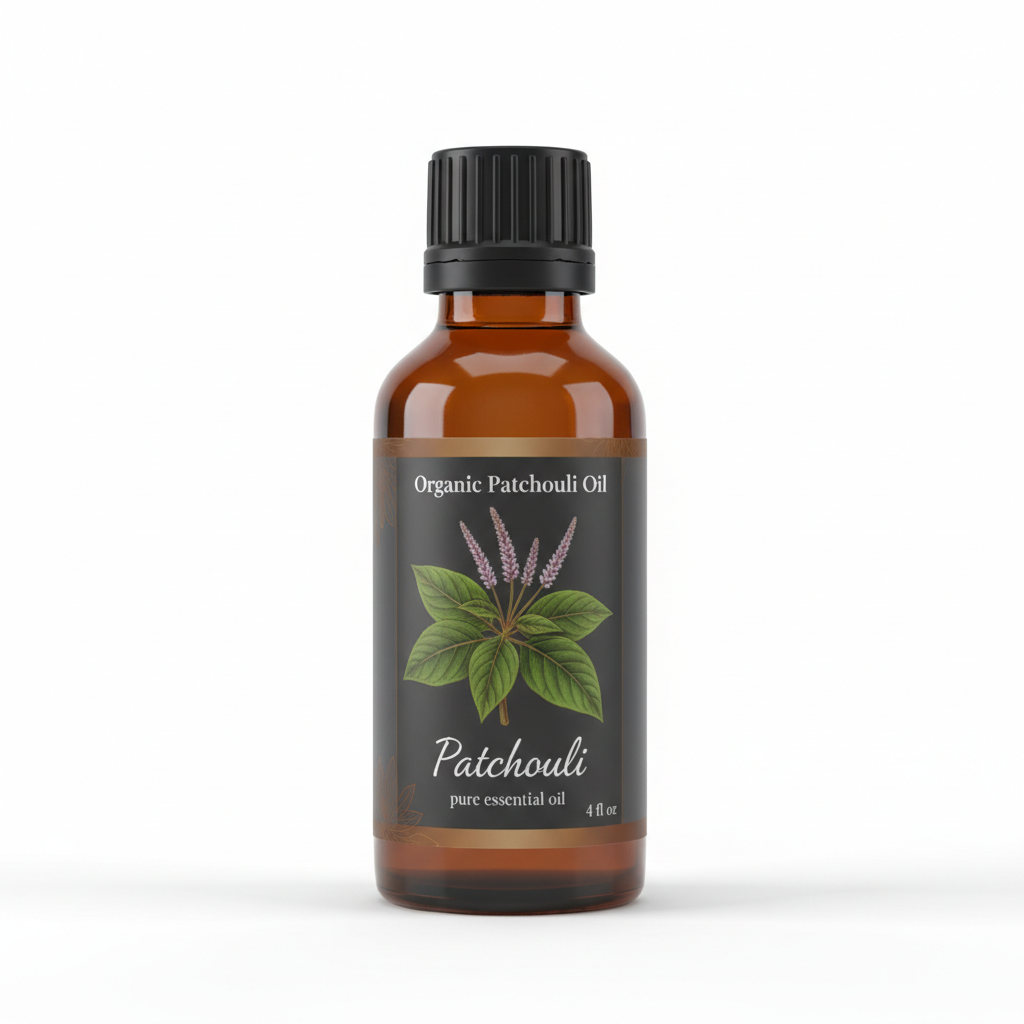
Patchouli Essential Oil
Our own Patchouli Essential Oil, in sizes from 0.5 oz to bulk.
From $20.99
Shop Now →A cast of companions
An old perfume patent describes patchoulol and a smaller relative, norpatchoulenol, as the fragrance-determining substances in natural patchouli oil (US4704477A - Trimethylcyclohexene derivatives, their preparation and use as perfume substances - Google Patents). The fuller picture comes from the European Food Safety Authority's feed-additive panel, which ran GC-MS on five batches of one patchouli leaf oil. Patchoulol averaged 34%, with the five batches sitting close together at 33.5% to 34.5%. Next came alpha-bulnesene at about 17%, 1(5),11-guaiadiene at about 15% and beta-caryophyllene at nearly 4%. Seychellene and the alpha- and beta-patchoulenes filled in most of the rest, and roughly eighteen compounds together made up about 98% of what the instrument saw (Safety and efficacy of a feed additive consisting of an essential oil derived from the leaves of Pogostemon cablin Benth. (patchouli oil) for use in all animal species (FEFANA asbl)).
Read that as a recipe rather than a ranking. Patchoulol is the biggest single ingredient, which is why analysts use it as the marker, but the woody, earthy, slightly sweet character of the oil comes from the whole group playing together. Even the small ones, like pogostol at under 1%, are part of the profile.
Why one report never matches another
Look across the literature and patchoulol in distilled leaf oil runs from the low 20s to the high 30s in percent. A Guangdong leaf oil in one review came in at 37.5%, Vietnamese oil at 32% to 37%, and an Indonesian-type oil in an older PROSEA entry at 26.7% (A Comprehensive Review on the Phytochemical Constituents and Pharmacological Activities of Pogostemon cablin Benth.: An Aromatic Medicinal Plant of Industrial Importance.; Pogostemon (PROSEA) - Pl@ntUse). Several things push the figure around:
- Chemotype. Two chemical types of the plant are recognised, one rich in patchoulol and one rich in pogostone. The same species, with a different fingerprint.
- Plant part. Stem oil carries far less patchoulol than leaf oil in the same review, 10% against 37.5%, which is one reason leaf is the part that matters.
- Harvest timing. In a Hainan study the review relays, patchoulol was highest in leaf cut in June, and oil yield slipped from 0.8% in June to 0.6% in August.
- Still time. PROSEA describes runs of 6 to 8 hours for a 75 to 100 kg charge of leaf, sometimes much longer, because the most desirable fractions come over last.
- Extraction method. A supercritical CO2 study reports higher patchoulol in extracts than in distilled oil and links the gap to heat (Characterization of Bioactive Compounds from Patchouli Extracted via Supercritical Carbon Dioxide (SC-CO2) Extraction). That is the authors' interpretation, and it is a good reason to compare steam-distilled oil with steam-distilled oil.
What a percentage actually measures
The figures in the EFSA tables are percent of GC area: each compound's share of the total detector signal, with every detected peak counted as 100%. That is a handy way to compare compounds inside one run, but it is not the same as grams per hundred grams. The method matters too. The same opinion records a GC-FID figure of 29.64% patchoulol for a batch, against the 34.01% GC-MS average across five. A few points of difference between two honest instruments is normal, so a report from one lab and a report from another are not directly comparable.
So we would not shop for the highest patchoulol number. A marker percentage is not a quality grade, and a very high figure can just as easily point to a different chemotype or a different extraction as to a better oil. What a full GC-MS report does give you is the whole profile, the method and the batch it came from, which is what you want in front of you when you compare one oil with another. If you want a longer walk through reading one, our GC-MS guide takes it line by line, and how patchouli oil is made covers the drying, curing and still time behind these numbers.
Chemistry and your nose
It is easy to lose the scent in the numbers, so we like to pair any report with a slow smell. Dip a paper blotter, set it down, and come back to it after a few minutes and again the next day. You'll notice the bright, rough edges fade first and the deep, woody, earthy middle linger. That change is the chemistry at work, even if you never read a single percentage.
If you are choosing between oils, do both: read the report if one exists, and use your nose as a second opinion. Neither one tells the whole story alone.
What comes with our oil
We sell a steam-distilled patchouli leaf oil, Pogostemon cablin, and the Certificate of Analysis for one batch lists its appearance and smell along with standard ranges for density, refractive index and optical rotation. If you need a GC-MS profile for formulation or quality work, ask us in writing through the contact page before you order and we will tell you what we can provide. Pairing a chemistry report with a plain sniff test, the way our scent profile describes it, is still the best way to choose an oil.
It is a lovely thing that a leaf oil this complex can be summed up in one word on a label. The word is the doorway; the rest of the molecules are the room.
Patchouli Essential Oil
Patchouli Essential Oil from our own shop, in sizes from 0.5 oz to bulk.
From $20.99
Shop Now →Sources & Further Reading
- Safety and efficacy of a feed additive consisting of an essential oil derived from the leaves of Pogostemon cablin Benth. (patchouli oil) for use in all animal species (FEFANA asbl), EFSA Journal, 2025
- A Comprehensive Review on the Phytochemical Constituents and Pharmacological Activities of Pogostemon cablin Benth.: An Aromatic Medicinal Plant of Industrial Importance., Molecules, 2015
- Pogostemon (PROSEA) - Pl@ntUse
- Characterization of Bioactive Compounds from Patchouli Extracted via Supercritical Carbon Dioxide (SC-CO2) Extraction, Molecules, 2022
- US4704477A - Trimethylcyclohexene derivatives, their preparation and use as perfume substances - Google Patents